



While on the road this week, I found myself lightly defending open source/weight AI models, with much of the news stemming from reports the Trump Administration is figuring out what to do about a new open-weight model from China called Kimi K3.
There’s also more talk of government “kill switches” on American AI models, which has implications abroad.
I provide more details on both below.
Kimi K3 and Open Weight/Source AI Models
David Sacks, President Trump’s former AI czar, this week highlighted that Kimi K3 — the latest-and-greatest AI model developed by the Chinese startup Moonshot AI — was used to fix security issues that U.S.-based models were allegedly refusing to help due to “cyber guardrails.”
Besides doing what American models won’t in some cases, why is this new model helpful?
One reason is that Kimi K3 is an open-weight model. According to Stanford University, an open-weight model is “an AI model whose core components are publicly released, allowing anyone to download it. This lets users run the model on their own computers, study how it works, and even modify it for their own specific needs.” While they differ from open-source models in terms of what elements of the model are available, open-weight models are useful.
Apparently, they’re very useful. Nvidia, joined by more than twenty other companies like Microsoft and Meta, released a statement this week in support of open-weight models in which they highlighted their benefits: expanded access across business and educational institutions, widely shared AI advancements, and greater control among deployers. According to the statement, one downside is that modified versions are difficult to track or reverse but “the right response to this risk is not to prohibit open weights.”
Innovation starts with access. Banning open weights is the last thing we need.
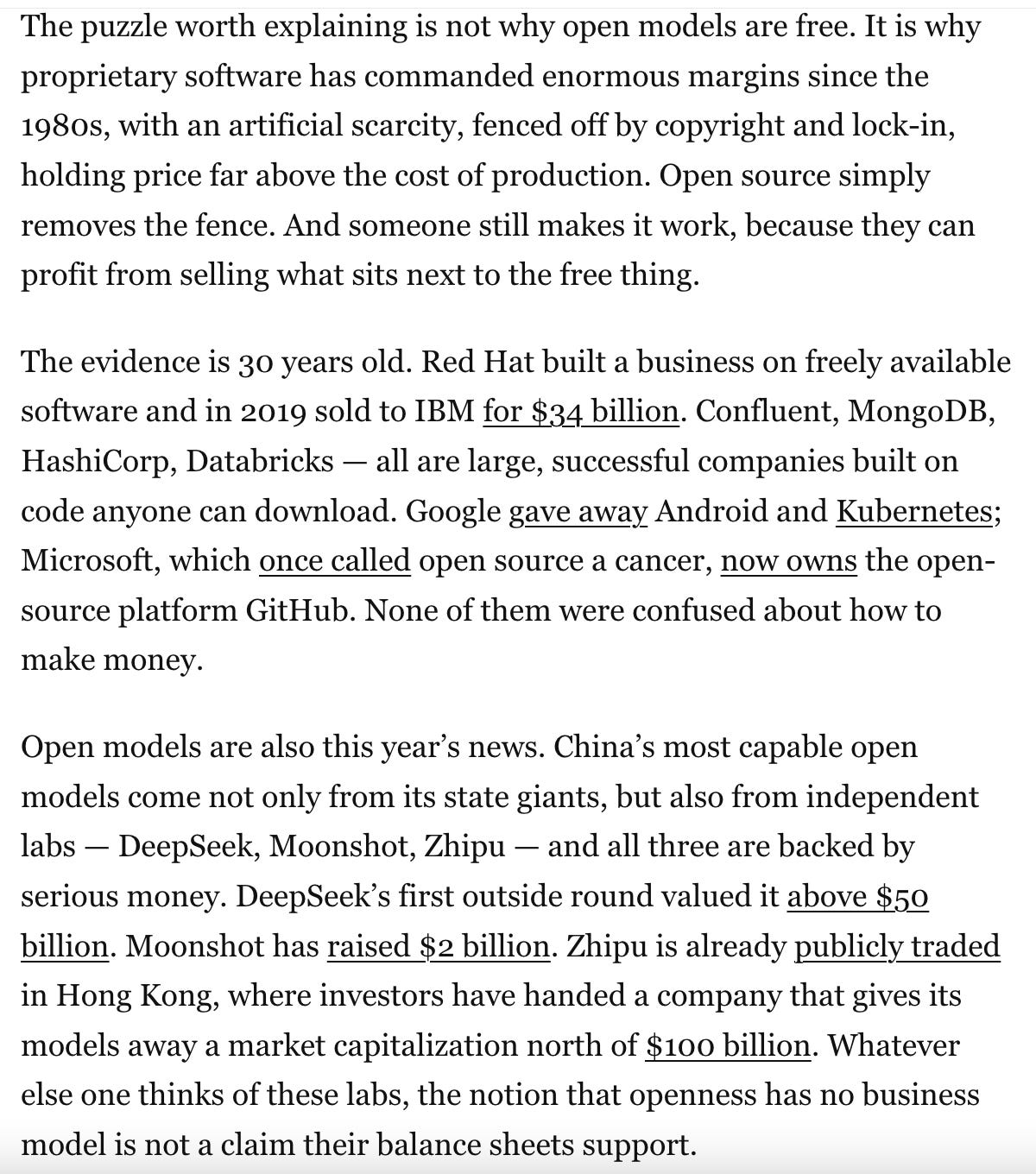
Another angle highlighted this week was “open-sourcing” as competition for AI companies. An op-ed published in the Washington Post argued that releasing software for free is a tried-and-true business model.
Per the article:
This isn’t a defense of Chinese AI models. It’s a call for the United States to step up with our own frontier open models to compete.
Fortunately, some American companies are moving in that direction. Companies like Reflection, Thinking Machines, and Nvidia are all at various stages of developing frontier open models as we speak.
That’s good for a few reasons. Keeping the market competitive should help diffuse power away from just a few major AI companies. And if these models prove useful, we’ll have more AI models on hand to tackle cybersecurity threats and infrastructure vulnerabilities as they arise.
While I’m still working through the First Amendment side of things when it comes to model types specifically, Jacob Robinson released a podcast episode on this topics that’s worth your time. I recommend jumping straight to Preston Byrne’s take on open models and the First Amendment at 53:25.
“Kill Switches”
Reporting this week revealed that State Department Secretary Marco Rubio wants American diplomats to push back against the idea that the United States has a “kill switch” over American AI models.
You might remember that the federal government barred access to Anthropic’s Fable 5 and Mythos 5 for non-citizens in June. Other countries are likely wondering whether they can rely on American models or whether a home-grown option is safer. No wonder the State Department is working on damage control right now.
Against that backdrop, the White House’s efforts to get companies to voluntarily submit their frontier models will be formalized on August 1. That’s because of a 60-day deadline from the President’s June 2 Executive Order for federal national security leadership to come up with benchmarks to figure out what “covered frontier models” means and to draw up the voluntary process to give the federal government and trusted partners access to the model.
In addition, a bill in Congress was introduced this week called the “AI Kill Switch Act.” It would authorize the Secretary of Homeland Security to create rules requiring AI companies to have “a technical capability” to carry out the following:
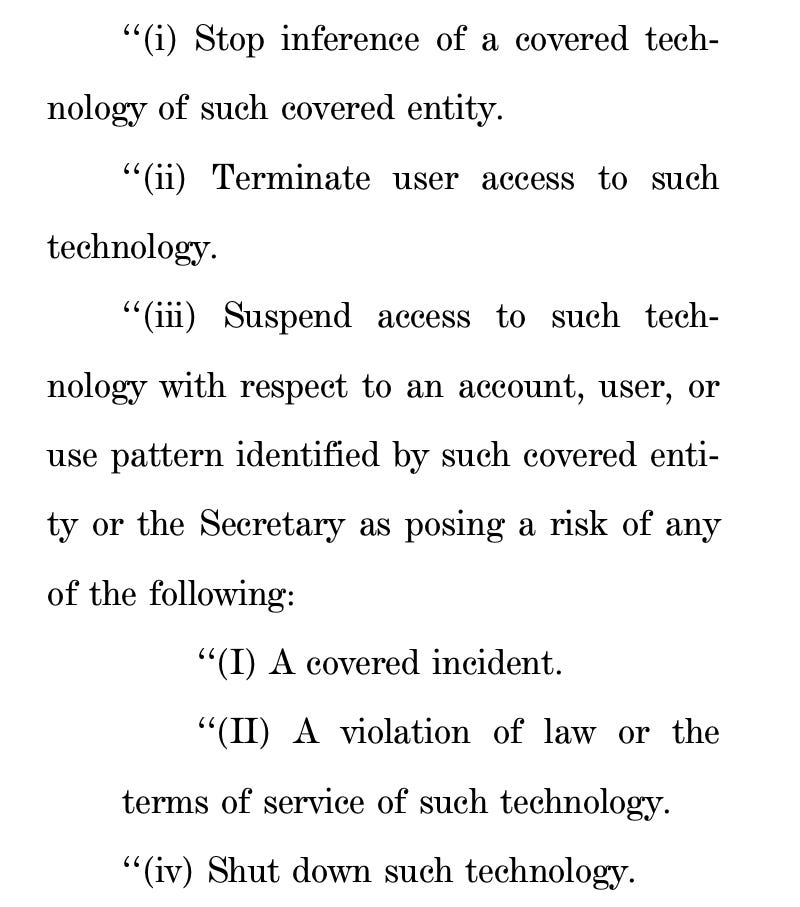
Maybe a “kill switch” isn’t such a good idea if you want global AI dominance. Building a track record of cutting off the technology from the rest of the world tells our friends and allies that American technology might not always be there for them. Formalizing that into law would make it worse.
Moreover, when I see “technical capability” here, I think code. I’m not too big on the idea of the Department of Homeland Security overseeing how kill switches are coded into models. As Adam Thierer notes, that’s “ripe for abuse.”
I agree.
We should take a step back and reassess how we can be the best in the world.